Sign a defensible RTW form in 90 seconds. Free, forever. No app to install.
A smart RTW form with AMA OEM guidance and age-adjusted BLS benchmarks at the point of care. It drafts least-restrictive, guideline-informed restrictions for you to review, suggests an anticipated-MMI timeframe from ACOEM-cited course data, then quality-checks everything before you sign. Adjusters and employers receive the signed PDF the moment you tap finish — so the phone stops ringing.
What a 90-second visit close looks like
Pre-filled from the FNOL. Evidence inline. AI checks before you sign.
Five things you won't have to do.
Pre-filled from the carrier's FNOL: name, DOB, occupation, body part, injury date.
Off work · modified · full duty with auto-generated restriction text from the AMA OEM library.
Median days away from work for this injury × body part shown inline — adjusted to the worker's age band. You're either inside the curve or out of it — explicitly.
AI quality check flags inconsistencies (e.g. 'full duty' + lifting restriction) before the signature button activates.
One tap signs the PDF. We route it to the adjuster, employer, and worker — and your part is done.
The form drafts the restrictions. You sign them.
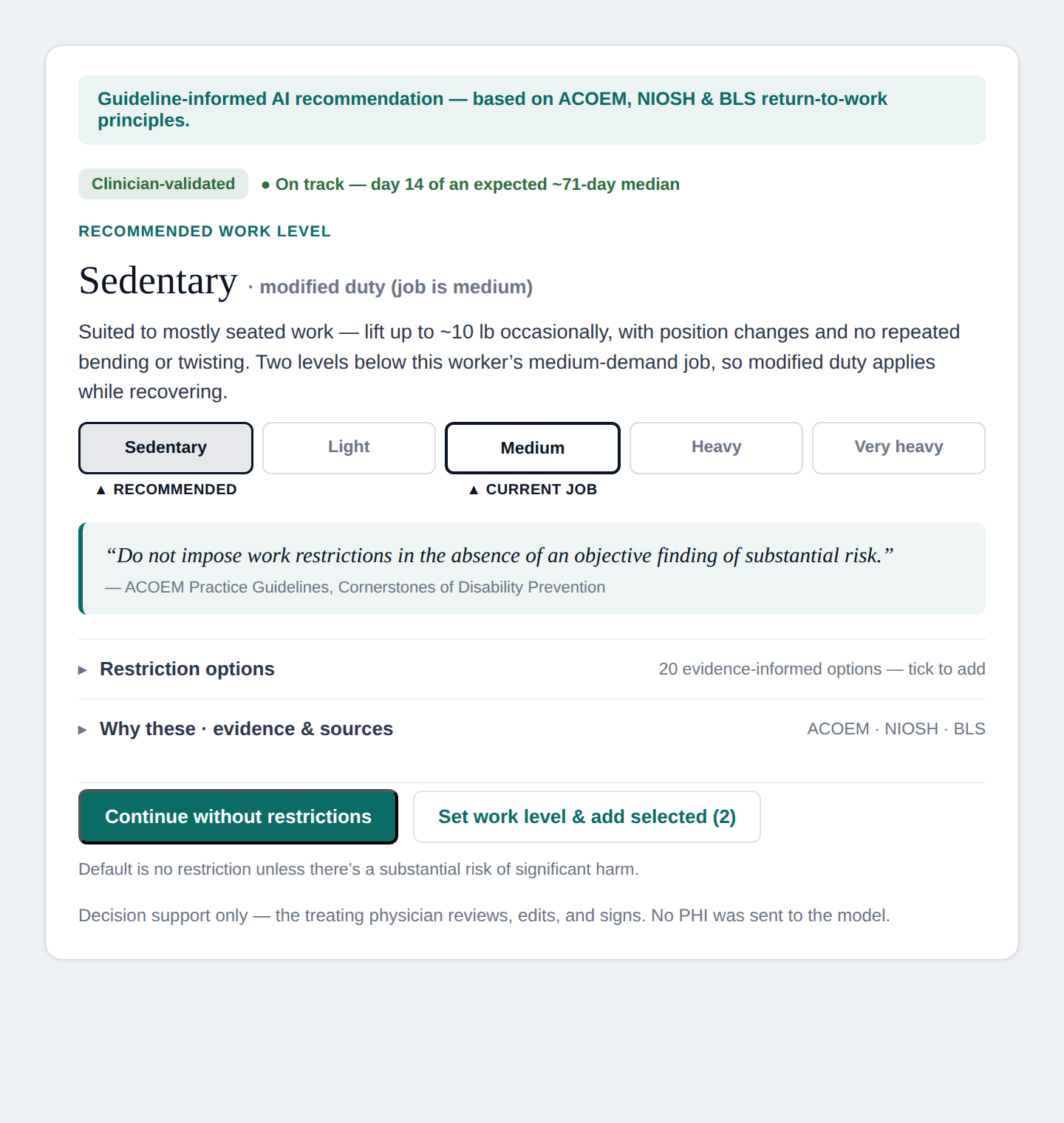
An AI assist suggests a least-restrictive, evidence-informed work status — you stay the decision-maker.
Evidence at the point of decision — never a mandate.
A draft work status and restriction set from a clinician-reviewed library built on ACOEM, NIOSH, and BLS return-to-work principles — keyed to the diagnosis, recovery phase, and the worker's job demand.
It starts from 'no restriction unless there's a substantial risk of significant harm' and shows the evidence behind each option — so you're never nudged to over-restrict.
Every suggestion is decision support: review, edit, or skip it, then sign. Nothing is filed automatically.
On every follow-up, an anticipated-MMI timeframe from ACOEM-cited clinical course data and BLS medians — counted forward from today's visit, not the injury date, with the worker's age band shown for context. You confirm or override.
Suggestions are generated from de-identified inputs — no patient identifiers are sent to the model.
The form lands in four places the same day you sign: the adjuster's queue, the employer's case file, the injured worker's portal, and your own audit log. No faxes. No “did you sign?” calls.
When a case reaches MMI, RTW Hub computes whole-person impairment using AMA Guides (5th ed.) methodology — deterministic category logic, an auditable calculation trail, and a signed rating report delivered like every other form. Piloting with our founding physicians now; ask about it on a demo call.
Two minutes. No contract. No app to install.
You get added to a panel by the employer; we send you an invite link.
- 1.American Medical Association · Guides to the Evaluation of Work Ability and Return to Work, 4th ed.
- 2.U.S. Bureau of Labor Statistics · SOII 2023–24 median days-away-from-work, by occupation × body part; age-band adjustment from BLS SOII demographic tables.
- 3.ACOEM · Occupational Medicine Practice Guidelines — return-to-work and disability duration principles; cited timeframes reviewed by our clinical lead.
- 4.American Medical Association · Guides to the Evaluation of Permanent Impairment, 5th ed. (impairment-rating pilot).
- 5.RTW Hub corpus · AI quality-check flags logged with rationale; reviewable per case.